
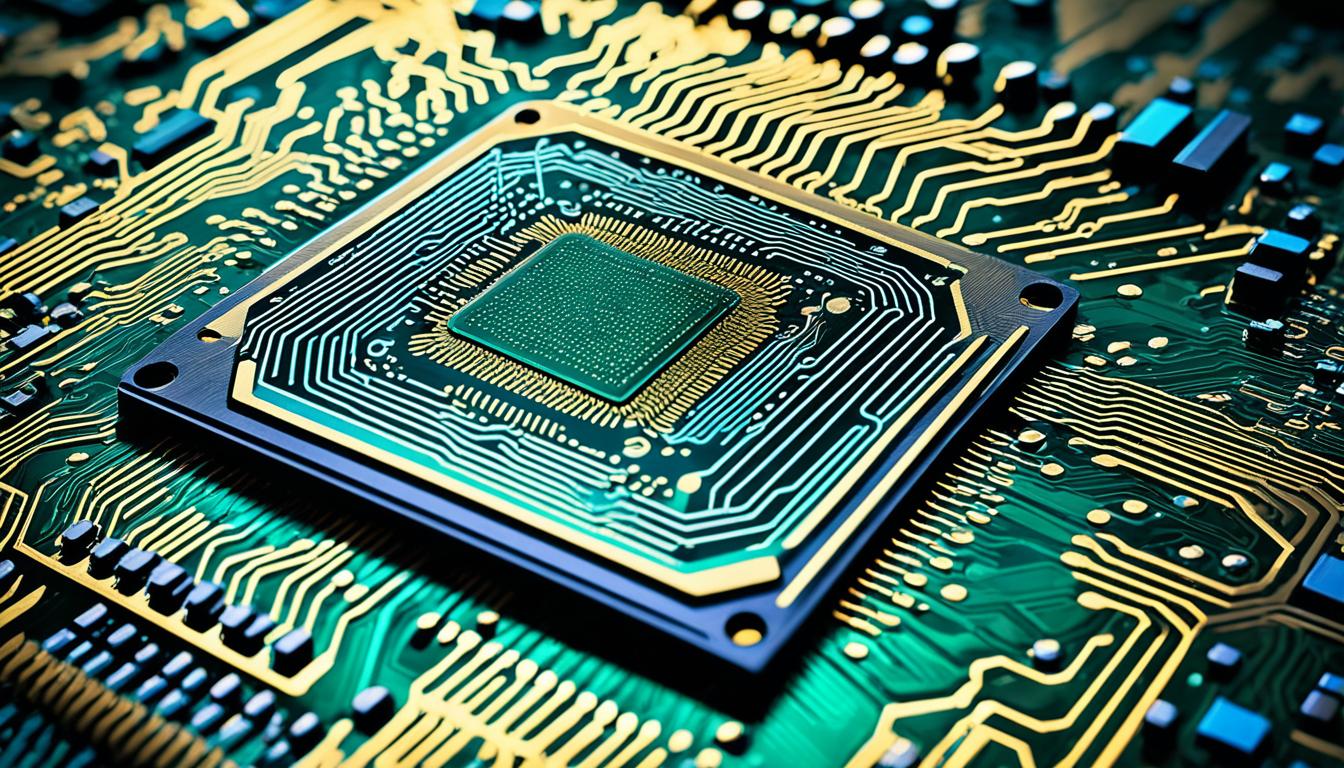
Did you know that AI chip technology is projected to reach a market value of approximately $89.6 billion by 2029? This staggering statistic highlights the immense scale of the impact that AI chips, also known as artificial intelligence chips, are having on the world of technology and innovation.
AI chips play a crucial role in implementing AI at a cost-effective scale, providing the necessary hardware to support the efficient calculations required by AI systems. These specialized chips, such as AI processors, neural processing units, and machine learning chips, are designed to outperform older generations of chips and offer significant cost savings.
The intricate supply chains involved in producing AI chips are primarily concentrated in the United States and a few allied democracies. This concentration presents an opportunity for export control policies and highlights the strategic importance of AI chip technology.
Keep reading to discover the importance of AI chips in AI development and deployment, the role of AI chips in AI chip design trends, the growing demand for AI chips, the latest trends in AI chip development, and the investments being made in the future of AI chips.
Key Takeaways:
- AI chip technology is expected to reach a market value of around $89.6 billion by 2029.
- AI chips are essential for cost-effective implementation of AI systems.
- Specialized AI chips outperform older generations of chips and offer significant cost savings.
- The production of AI chips is concentrated in the United States and a few allied democracies.
- Investments in AI chip technology are essential for driving further advancements in AI technology.
Importance of AI Chips in AI Development and Deployment
AI chips play a critical role in the development and deployment of advanced AI systems. These specialized chips, such as graphics processing units (GPUs), field-programmable gate arrays (FPGAs), and application-specific integrated circuits (ASICs), are designed to handle the complex calculations required by AI algorithms. Compared to general-purpose chips like central processing units (CPUs), AI chips offer significant advantages in terms of speed and efficiency.
In fact, AI chips can be tens to thousands of times faster and more efficient than CPUs. This remarkable performance allows for cost-effective and rapid AI algorithm training and deployment. Using older AI chips or general-purpose chips would result in significantly longer training times and higher costs.
State-of-the-art AI chips are crucial for staying at the forefront of AI technology. With the constant advancements in AI techniques and applications, it is essential to have the latest AI hardware to optimize performance and achieve desired results. Whether it’s computer vision tasks, natural language processing, or machine learning, AI chips enable faster and more accurate computations, delivering more reliable and efficient AI systems.
By utilizing AI chips, developers and researchers can push the boundaries of AI technology, explore new frontiers, and drive innovation. These chips provide the necessary horsepower to accelerate AI algorithms, leading to breakthroughs in AI research and real-world applications.
The Role of AI Chips in AI Hardware
AI chips are a critical component of AI hardware, providing the processing power needed to execute AI algorithms effectively. They are tailored to handle the specific requirements of AI systems, such as parallel computing, low-precision calculations, and efficient memory access.
Parallel computing is a key feature of AI chips that allows for simultaneous computation of multiple data points, significantly speeding up processing times. This parallelism enables AI algorithms to process large datasets and complex models more efficiently.
Low-precision calculations are another advantage of AI chips. They can perform calculations with reduced precision, allowing for faster processing while maintaining acceptable accuracy levels. This capability is particularly useful in AI applications where the focus is on speed and real-time decision-making.
Efficient memory access is crucial for AI algorithms, which often require large amounts of data to be processed. AI chips optimize memory access patterns, ensuring fast and efficient retrieval and storage of data, enhancing overall performance.
With these AI-optimized design features, AI chips outperform general-purpose chips, making them indispensable for AI hardware development and deployment.
Role of AI Chips in AI Chip Design Trends
The semiconductor industry is undergoing a significant transformation as the demand for AI applications continues to rise and the improvements in CPU performance driven by Moore’s Law start slowing down. As a result, there is a shifting focus from general-purpose chips to specialized AI chips. These AI chips are specifically designed to meet the computational requirements of AI systems efficiently.
AI chips incorporate AI-optimized design features that enable them to perform AI-specific calculations with increased speed and enhanced efficiency. These design features, such as parallel computing, low-precision calculation, and efficient memory access, contribute to a significant improvement in performance compared to CPUs.
Different types of AI chips, including GPUs, FPGAs, and ASICs, offer unique advantages and are suitable for various AI tasks, such as training and inference. These leading-edge chips play a vital role in driving advancements in AI chip design trends and enabling the development of AI algorithms and applications.
Innovative AI-optimized Design Features
To further understand the role of AI chips in AI chip design trends, let’s take a closer look at some of the innovative AI-optimized design features:
| Design Feature | Description |
|---|---|
| Parallel Computing | AI chips leverage parallel computing techniques to perform multiple calculations simultaneously, significantly accelerating AI algorithms and reducing processing time. |
| Low-Precision Calculation | AI chips utilize low-precision calculation methods, such as reduced bit width, to achieve faster processing speeds while maintaining computational accuracy. |
| Efficient Memory Access | Efficient memory access techniques, such as on-chip memory and cache optimization, minimize data retrieval time and enhance overall performance. |
These AI-optimized design features are crucial for meeting the demanding computational requirements of AI applications, allowing for faster processing, improved energy efficiency, and enhanced performance.
The Growing Demand for AI Chips
The global AI chip market is poised for substantial growth in the coming years, as the adoption of AI technology continues to accelerate across industries. It is projected to reach a value of US$ 89.6 billion by 2029.
One of the key drivers of this demand is the increasing integration of AI chips into consumer electronics, such as laptops, desktops, and gaming consoles. These devices benefit from AI chips by enabling advanced features like voice recognition and real-time decision-making, enhancing user experiences.
Furthermore, the ongoing innovation in AI chip technology is fueling market growth. Companies are investing heavily in research and development to create chips with improved performance and capabilities. These advancements include enhanced processing power, energy efficiency, and specialized features optimized for AI tasks.
Additionally, the growing demand for cloud computing and the increasing utilization of AI in the Internet of Things (IoT) are driving the demand for AI chips. Cloud-based AI applications require high-performance hardware to deliver efficient and reliable AI services, while the integration of AI in IoT devices necessitates AI chips for local processing and decision-making.
With the rapid pace of AI technology adoption and the continuous innovation in AI chip design, the demand for AI chips is expected to remain strong. Continued investments and advancements in this field will play a crucial role in shaping the future of AI technology.
Latest Trends in AI Chip Development
The field of AI chip development is rapidly evolving, with companies like Nvidia, Sapeon, Microsoft, and NXP Semiconductors leading the way. These industry giants are introducing cutting-edge technologies and innovative solutions, pushing the boundaries of AI chip capabilities.
Nvidia’s Grace Hopper Superchip is a game-changer in the realm of AI applications. This next-generation AI chip is specifically designed to enhance the performance of generative AI applications, delivering unprecedented computational power and efficiency.
Sapeon’s X330 chip is another significant advancement in AI chip development. It promises higher computational performance, enabling faster and more efficient processing of complex AI algorithms. Additionally, it boasts remarkable power efficiency, making it an ideal choice for energy-conscious applications.
Microsoft, a key player in the tech industry, has introduced custom AI chips to meet the increasing demands of AI computing tasks. The Azure Maia 100 and Azure Cobalt 100 CPU are specifically tailored for AI applications, delivering optimized performance and efficiency.
NXP Semiconductors is also making waves in AI chip development with the launch of the i.MX 95 family. These chips integrate high-performance computing and machine learning acceleration, enabling a wide range of applications to leverage advanced AI capabilities.
| Company | AI Chip | Key Features |
|---|---|---|
| Nvidia | Grace Hopper Superchip | Enhanced performance for generative AI applications |
| Sapeon | X330 chip | Higher computational performance and power efficiency |
| Microsoft | Azure Maia 100 and Azure Cobalt 100 CPU | Custom AI chips designed for AI computing tasks |
| NXP Semiconductors | i.MX 95 family | Integration of high-performance computing and machine learning acceleration |
These advancements in AI chip development are revolutionizing the capabilities of AI systems, pushing the boundaries of what is possible. The introduction of next-generation AI chips, customized configurations, and high-performance solutions is shaping the future of AI technology.
Investing in the Future of AI Chips
Governments and private sectors globally recognize the importance of AI chips and are actively investing in their future. Through government initiatives, strategic partnerships, and funding for research and development, significant progress is being made to advance the capabilities of AI chips. These investments aim to drive innovation, enhance performance, and support the growth of indigenous AI development.
An excellent example of such collaboration is the partnership between Reliance Industries and NVIDIA in India. By joining forces, they are pushing the boundaries of AI technology and contributing to the development of AI and semiconductor chips within the country. This strategic partnership is crucial in harnessing the potential of AI and building a thriving ecosystem for further advancements.
Furthermore, the adoption of advanced technologies like computer vision, big data, augmented reality (AR), virtual reality (VR), and quantum computing continues to fuel the demand for AI chips. This widespread use of cutting-edge technologies across various industries drives the need for more powerful and efficient AI chips to meet the growing computational requirements.
Government Initiatives and Strategic Partnerships
| Country/Company | Initiative/Partnership |
|---|---|
| India | Reliance Industries and NVIDIA partnership to advance AI technology |
| United States | National AI Initiative and collaborations between tech giants and research institutions |
| China | Strategic partnership between Baidu and the Chinese government to accelerate AI development |
| Canada | Investments in research and development through organizations like CIFAR and Vector Institute |
These ongoing investments in AI chip technology demonstrate a strong commitment to driving innovation and fostering the growth of AI ecosystems. With increased funding for research and development, governments and private sectors are poised to unlock the full potential of AI chips and propel the future of artificial intelligence.
Conclusion
The advancements in AI chip technology have revolutionized the field of artificial intelligence, enabling the development and deployment of advanced AI systems. With the increasing adoption of AI across industries, the demand for AI chips is expected to continue growing.
The future of AI chip technology looks promising, driven by ongoing innovation in AI chip design. Companies, governments, and research organizations recognize the importance of investing in the development of AI chips to unlock their full potential and drive further advancements in AI technology.
As the AI chip market outlook remains positive, it is crucial for stakeholders to understand the significance of AI chip technology in shaping the future of artificial intelligence. By continuing to invest in research and development and fostering strategic partnerships, we can accelerate the growth of the AI chip market and ensure a bright future for AI technology.